Protein Powder Macros: Complete Nutrition Facts & Calories
Reviewed by Sarah Chen, MS, RD
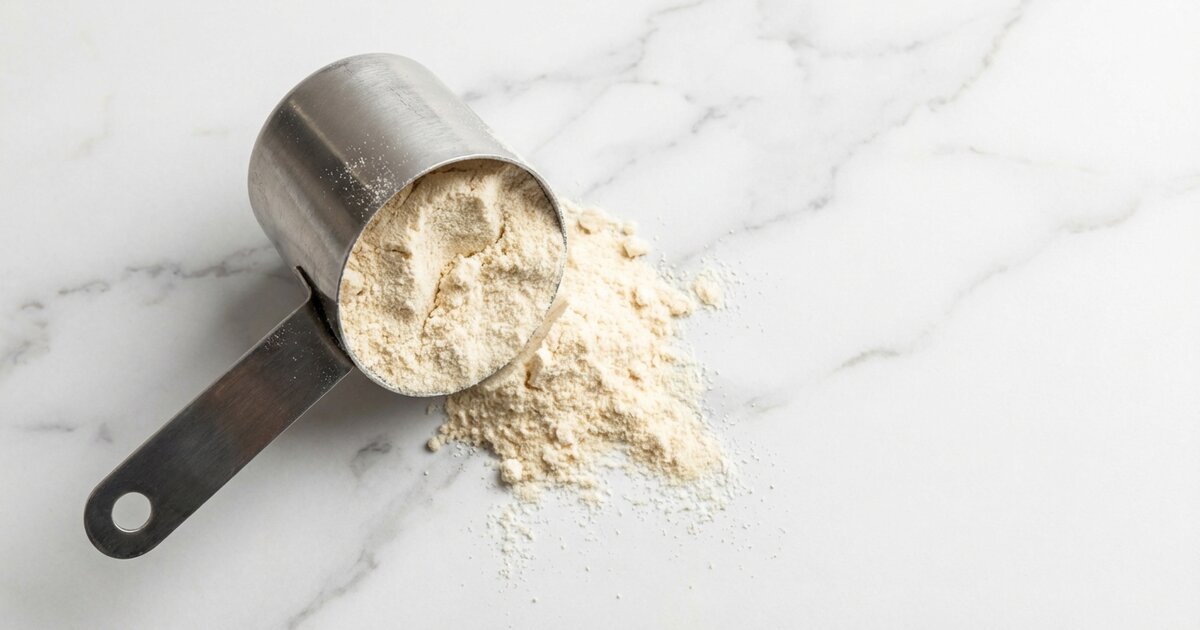
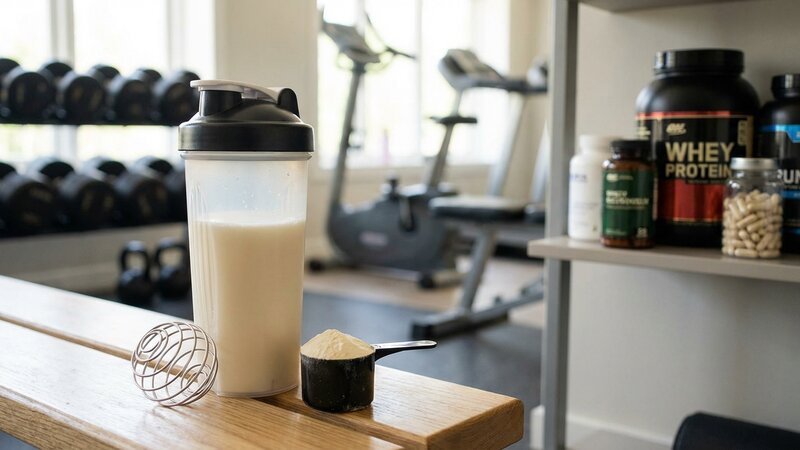
Protein powder is the most popular sports supplement for good reason—it’s an efficient, convenient way to hit your protein targets. But the protein powder market is overwhelming: whey vs. plant, isolate vs. concentrate, dozens of brands with wildly different macros.
This guide cuts through the confusion. You’ll learn exact macros for every protein powder type, how to compare products, and how to choose the right protein for your specific goals.
Related: Learn more about what macros are and how they impact your diet.
Protein Powder Macros: Quick Reference
Here’s what you need to know for the most common protein powder types.
Whey Protein Concentrate
| Serving | Calories | Protein | Carbs | Fat |
|---|---|---|---|---|
| 1 scoop (30g) | 120 | 22-24g | 3-4g | 1.5-2g |
| 2 scoops (60g) | 240 | 44-48g | 6-8g | 3-4g |
| Per 100g powder | 400 | 73-80g | 10-13g | 5-7g |
Whey Protein Isolate
| Serving | Calories | Protein | Carbs | Fat |
|---|---|---|---|---|
| 1 scoop (30g) | 110 | 25-27g | 1-2g | 0.5-1g |
| 2 scoops (60g) | 220 | 50-54g | 2-4g | 1-2g |
| Per 100g powder | 367 | 83-90g | 3-7g | 2-3g |
Casein Protein
| Serving | Calories | Protein | Carbs | Fat |
|---|---|---|---|---|
| 1 scoop (33g) | 120 | 24g | 3g | 1g |
| Per 100g powder | 364 | 73g | 9g | 3g |
Plant-Based Protein (Pea/Rice Blend)
| Serving | Calories | Protein | Carbs | Fat |
|---|---|---|---|---|
| 1 scoop (30g) | 120 | 21-24g | 4-6g | 2-3g |
| Per 100g powder | 400 | 70-80g | 13-20g | 7-10g |
Key insight: Whey isolate has the highest protein percentage and lowest carbs/fats. Concentrate is cheaper with slightly more carbs and fat. Both are effective.
Understanding Protein Powder Types
Whey Protein: The Gold Standard
Whey comes from milk (the liquid separated during cheese production). It’s fast-digesting and contains all essential amino acids.
Whey Concentrate:
- 70-80% protein by weight
- Contains some lactose and fat
- Cheaper than isolate
- Good for most people
- Creamier texture
Whey Isolate:
- 90%+ protein by weight
- Minimal lactose and fat
- More expensive
- Better for lactose-sensitive individuals
- Mixes thinner
Whey Hydrolysate:
- Pre-digested (broken into smaller peptides)
- Fastest absorption
- Most expensive
- Slightly bitter taste
- Marginal benefits for most people
Concentrate vs. Isolate Comparison
| Factor | Concentrate | Isolate |
|---|---|---|
| Protein % | 70-80% | 90%+ |
| Calories/scoop | 120 | 110 |
| Carbs | 3-4g | 1-2g |
| Fat | 1.5-2g | 0.5-1g |
| Lactose | Some | Minimal |
| Price | Lower | Higher |
| Taste | Creamier | Thinner |
Bottom line: Isolate is “purer” but concentrate is more cost-effective. Unless you’re lactose intolerant or counting every gram, concentrate works fine.
Casein Protein
Casein is the other milk protein (80% of milk protein vs. 20% whey). It digests slowly over 6-8 hours.
Best uses:
- Before bed (provides amino acids overnight)
- Between meals (sustained satiety)
- When you won’t eat for several hours
Not ideal for:
- Post-workout (whey is faster)
- Smoothies (very thick texture)
Plant-Based Proteins
For vegans or those avoiding dairy:
Pea Protein:
- 80%+ protein
- High in BCAAs
- Low allergen potential
- Earthy taste
Rice Protein:
- Complementary amino acids to pea
- Mild flavor
- Lower in lysine (pair with pea)
Soy Protein:
- Complete protein
- Well-studied
- Concerns about phytoestrogens (largely unfounded at normal doses)
Blends (Pea + Rice):
- Best plant option
- Complete amino acid profile
- Comparable to whey for muscle building
Plant vs. Whey Comparison
| Per Scoop (30g) | Whey Isolate | Plant Blend |
|---|---|---|
| Calories | 110 | 120 |
| Protein | 26g | 22g |
| BCAAs | 5.5g | 4.5g |
| Leucine | 2.5g | 1.8g |
| Digestion | Fast | Moderate |
| Complete protein | Yes | Yes (blends) |
For muscle building: Whey has a slight edge due to higher leucine and faster absorption. Plant proteins are close and work well for most people.
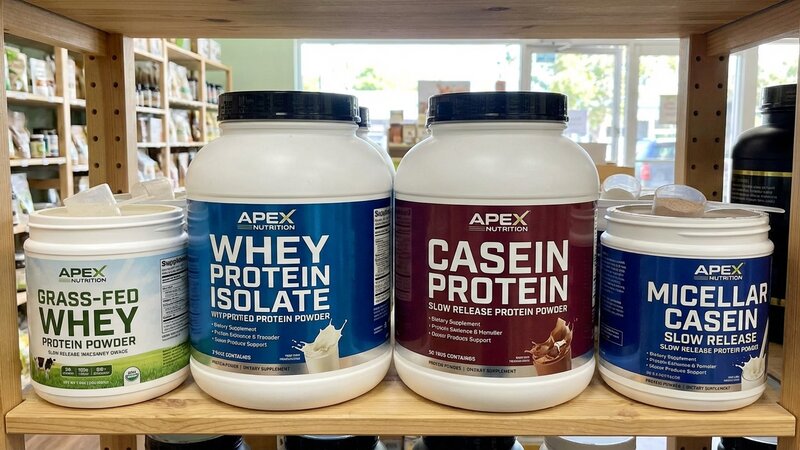
How to Read Protein Powder Labels
The Protein Percentage Calculation
Formula: (Protein per serving ÷ Serving size) × 100 = Protein %
Example:
- Label: 25g protein per 30g scoop
- Calculation: 25 ÷ 30 × 100 = 83%
- This is a decent whey isolate
Red flags:
- Less than 70% protein = lots of fillers
- Large scoop with low protein = bulked with carbs
- “Proprietary blends” hiding amounts
What to Look For
Good signs:
- Protein is first ingredient
- 70%+ protein by weight (concentrate) or 85%+ (isolate)
- Third-party tested (NSF, Informed Sport)
- Minimal ingredients
Warning signs:
- “Amino spiking” (cheap amino acids inflate protein count)
- Proprietary blends without amounts
- Very cheap prices (quality costs money)
- Too-good-to-be-true macros
Scoop Size Matters
Not all scoops are equal:
| Brand | Scoop Size | Protein | Protein % |
|---|---|---|---|
| Brand A | 30g | 24g | 80% |
| Brand B | 35g | 24g | 69% |
| Brand C | 40g | 25g | 63% |
Brand A gives you the most protein per gram of powder. Always check the serving size, not just the protein per serving.
Making Protein Powder Work for Different Goals
Weight Loss/Cutting
Protein powder supports cutting by:
- Increasing satiety
- Preserving muscle mass
- Providing protein with minimal calories
Best cutting choices:
- Whey isolate (highest protein %, lowest calories)
- Unflavored or naturally sweetened
- Avoid mass gainers (high calorie)
Cutting protein shake:
| Ingredient | Calories | Protein |
|---|---|---|
| 1 scoop whey isolate | 110 | 26g |
| 1 cup unsweetened almond milk | 30 | 1g |
| Ice | 0 | 0g |
| Total | 140 | 27g |
Muscle Building/Bulking
For building muscle, you need sufficient protein and calories:
Best bulking choices:
- Whey concentrate (good value, slightly more calories)
- Mass gainers (if struggling to eat enough)
- Casein before bed (overnight recovery)
Bulking protein shake:
| Ingredient | Calories | Protein | Carbs |
|---|---|---|---|
| 2 scoops whey | 240 | 48g | 6g |
| 1 cup whole milk | 150 | 8g | 12g |
| 1 banana | 105 | 1g | 27g |
| 2 tbsp peanut butter | 188 | 8g | 6g |
| 1/2 cup oats | 156 | 7g | 26g |
| Total | 839 | 72g | 77g |
Hitting Protein Targets
Most active people need 0.7-1g protein per pound of bodyweight:
| Bodyweight | Daily Protein | Scoops Needed* |
|---|---|---|
| 140 lbs | 100-140g | 1-2 |
| 170 lbs | 120-170g | 1-2 |
| 200 lbs | 140-200g | 2-3 |
*Assuming rest comes from food (meat, eggs, dairy, etc.)
Strategy:
- Get most protein from whole foods
- Use protein powder to fill gaps
- 1-2 scoops daily is typical
Meal Replacement
Protein shakes aren’t complete meals alone. Make them more substantial:
Meal replacement shake (500 cal):
| Ingredient | Calories | Protein |
|---|---|---|
| 1 scoop protein | 120 | 24g |
| 1 cup milk | 150 | 8g |
| 1 tbsp nut butter | 94 | 4g |
| 1/2 cup oats | 156 | 7g |
| 1/2 banana | 53 | 0.5g |
| Total | 573 | 43.5g |
Now you have protein, carbs, fats, and fiber—a real meal.
Protein Powder Recipes and Uses
Post-Workout Shakes
Basic recovery shake:
- 1 scoop whey + water/milk
- ~120-150 calories, 24-30g protein
Performance recovery shake:
| Ingredient | Calories | Protein | Carbs |
|---|---|---|---|
| 1 scoop whey | 120 | 24g | 3g |
| 1 banana | 105 | 1g | 27g |
| 1 cup milk | 150 | 8g | 12g |
| Total | 375 | 33g | 42g |
Protein-Boosted Foods
Protein oatmeal:
| Ingredient | Calories | Protein |
|---|---|---|
| 1/2 cup oats | 156 | 7g |
| 1 scoop protein | 120 | 24g |
| Water | 0 | 0g |
| Total | 276 | 31g |
Mix protein into oatmeal after cooking (heat denatures some protein but macros remain).
Protein pancakes:
- 1 scoop protein + 1 egg + 1/2 banana
- Mash/blend, cook like pancakes
- ~200 calories, 27g protein per batch
Protein coffee:
- 1 scoop unflavored/vanilla protein
- 8 oz hot or cold coffee
- ~120 calories, 24g protein
Baking with Protein Powder
Protein powder works in baking but behaves differently than flour:
Substitution ratio: Replace up to 1/3 of flour with protein powder
Tips:
- Add extra liquid (protein absorbs moisture)
- Don’t overbake (gets rubbery)
- Whey works better than plant proteins
- Unflavored is most versatile
Protein mug cake:
| Ingredient | Calories | Protein |
|---|---|---|
| 1 scoop protein | 120 | 24g |
| 1 egg | 70 | 6g |
| 2 tbsp cocoa | 24 | 2g |
| Splash of milk | 15 | 1g |
| Total | 229 | 33g |
Microwave 60-90 seconds.
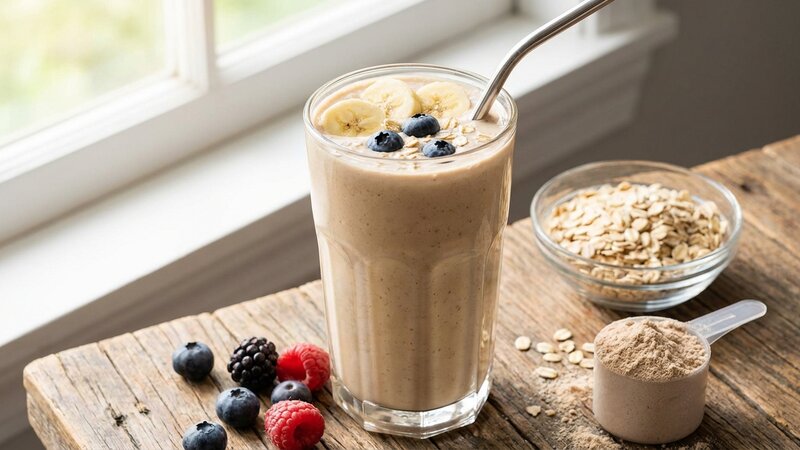
Protein Powder Timing
Post-Workout (Most Important)
Why it matters:
- Muscle protein synthesis elevated after training
- Fast-digesting protein maximizes this window
- Whey is ideal (fast absorption)
Timing: Within 2 hours post-workout (the “anabolic window” is longer than the 30-minute myth)
Before Bed
Why it matters:
- You fast 6-8+ hours during sleep
- Muscle breakdown can occur overnight
- Slow protein provides sustained amino acids
Best choice: Casein protein (digests over 6-8 hours)
Morning/Breakfast
Why it matters:
- Breaks overnight fast
- Starts protein intake for the day
- Sets up satiety
Good choice: Whey (fast digestion after fasting)
The Truth About Timing
What matters most: Total daily protein intake
What matters less: Precise timing
If you hit your daily protein target, timing becomes a minor optimization—not a requirement.
Comparing Popular Brands
Macro Comparison (Per Scoop)
| Brand/Type | Calories | Protein | Carbs | Fat | Price/lb |
|---|---|---|---|---|---|
| Optimum Nutrition Gold Standard | 120 | 24g | 3g | 1g | $$ |
| Dymatize ISO100 | 110 | 25g | 1g | 0.5g | $$$ |
| MyProtein Impact Whey | 103 | 21g | 1g | 1.9g | $ |
| Transparent Labs | 120 | 28g | 1g | 0.5g | $$$ |
| Orgain Organic Plant | 150 | 21g | 15g | 4g | $$ |
| Garden of Life Raw | 110 | 22g | 2g | 1.5g | $$$ |
Budget vs. Premium
Budget proteins ($15-20/lb):
- MyProtein, Bulk Supplements, store brands
- Same macros as premium
- May have less rigorous testing
- Flavors may be hit-or-miss
Premium proteins ($25-40/lb):
- Optimum Nutrition, Dymatize, Transparent Labs
- Third-party tested
- Better flavoring systems
- More consistent quality
Verdict: Macros are similar across price points. Premium brands offer better taste, testing, and consistency—but budget brands work fine.
Common Protein Powder Mistakes
Mistake #1: Not Checking Scoop Size
30g scoop with 24g protein vs. 45g scoop with 24g protein = very different products.
Fix: Calculate protein percentage (protein ÷ scoop size). Aim for 70%+ (concentrate) or 85%+ (isolate).
Mistake #2: Thinking More Is Better
Excess protein beyond your needs won’t build more muscle—it’s just extra calories.
Fix: Calculate your needs (0.7-1g per lb bodyweight). Don’t exceed by much.
Mistake #3: Replacing Too Many Meals
Protein powder lacks micronutrients, fiber, and food satisfaction.
Fix: Limit to 1-2 scoops daily. Get most protein from whole foods.
Mistake #4: Ignoring Added Sugars
Some protein powders have 10-15g sugar per serving (especially “lean” or mass gainers).
Fix: Check labels. Choose naturally sweetened or unflavored options.
Mistake #5: Expecting Magic
Protein powder is food, not a drug. It won’t build muscle without training or cause fat loss without a deficit.
Fix: Use protein powder as a convenient tool, not a solution.
Storage and Quality
How Long Does Protein Powder Last?
| Storage | Unopened | Opened |
|---|---|---|
| Cool, dry place | 18-24 months | 3-6 months |
| After expiration | Quality declines but safe for months | Use within 1-2 months |
Signs Protein Powder Has Gone Bad
- Clumping (moisture exposure)
- Off smell (rancid fats)
- Change in color
- Different taste
Note: Protein powder rarely becomes unsafe—it just loses quality.
Storage Tips
- Keep container sealed
- Store in cool, dry place
- Don’t refrigerate (moisture risk)
- Use included scoop (or weigh)
The Bottom Line
Protein powder is a convenient tool for hitting protein targets:
- 110-130 calories per scoop — Efficient protein delivery
- 20-27g protein per scoop — Depending on type
- Whey isolate — Highest protein %, lowest extras
- Concentrate — Best value, still very effective
Key tracking rules:
- Check scoop size and protein percentage
- Account for shake additions (milk, fruit, etc.)
- 1-2 scoops daily is typical (rest from food)
- Total daily protein matters more than timing
Whether you’re supplementing a cut, fueling muscle growth, or just making it easier to hit your protein targets, protein powder delivers predictable macros that fit any nutrition plan.
Related guides:
Related Articles
Dragonfruit Macros: Complete Nutrition Guide for Pitaya
Complete macro breakdown of dragonfruit (pitaya). Learn the calories, protein, carbs, and...
Read guide →
Bulgur Macros: Complete Nutritional Guide & Health Benefits
Discover bulgur's complete macro breakdown, nutritional benefits, and how to incorporate...
Read guide →
Radish Macros: Nutrition Facts and Health Benefits
Complete guide to radish macros and nutrition. Learn calories, protein, carbs, and health...
Read guide →Note: Nutrition values are approximate and may vary based on preparation method and source.