Quaker Oats Nutrition Macros
Reviewed by Dr. Michael Torres, PhD
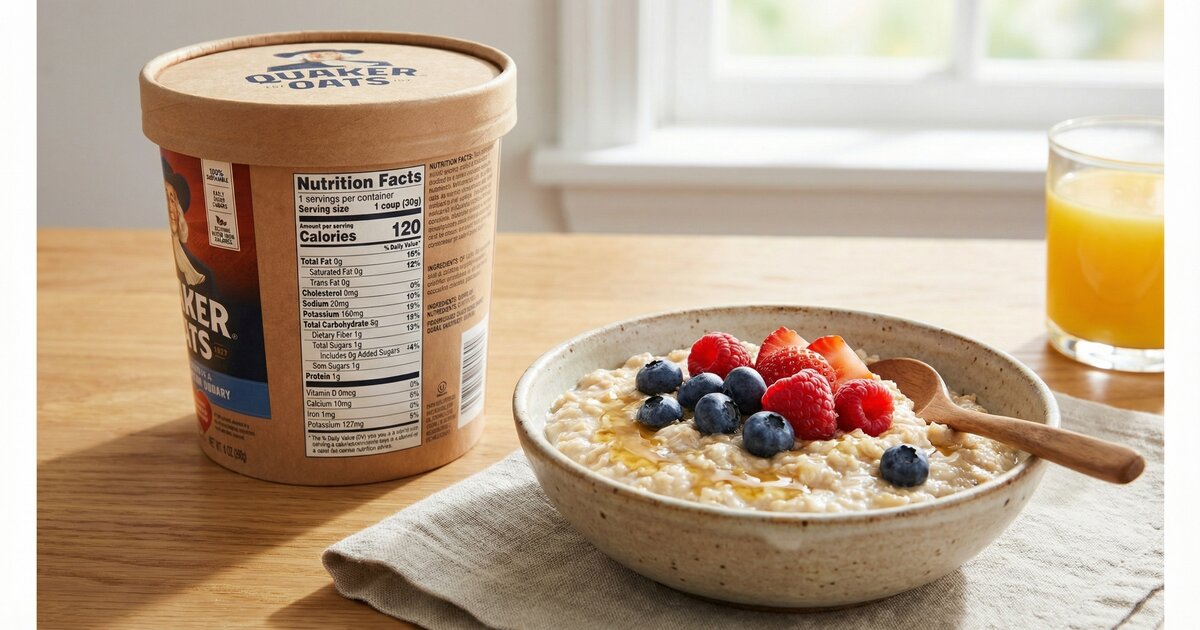
Quaker Oats has been a breakfast staple for over 140 years. The iconic cylindrical container is in millions of kitchens worldwide, and for good reason—oatmeal is one of the most nutritious, affordable breakfast options available.
For macro tracking, oatmeal is primarily a carbohydrate source with decent fiber and moderate protein. But not all Quaker products are equal—plain oats are nutritional powerhouses, while flavored instant packets can be sugar bombs.
This guide covers every Quaker oatmeal variety, explains the differences between oat types, and helps you fit oatmeal into any macro plan.
Related: Understand what macros are and why they matter for your nutrition goals.
Quaker Oatmeal Macro Overview
Here’s how Quaker’s main oat varieties compare:
| Product | Serving | Cal | Protein | Carbs | Fiber | Sugar | Fat |
|---|---|---|---|---|---|---|---|
| Old Fashioned Oats | 1/2 cup dry | 150 | 5g | 27g | 4g | 1g | 3g |
| Quick 1-Minute Oats | 1/2 cup dry | 150 | 5g | 27g | 4g | 1g | 3g |
| Steel Cut Oats | 1/4 cup dry | 150 | 5g | 27g | 4g | 0g | 2.5g |
| Instant Plain | 1 packet | 100 | 4g | 19g | 3g | 0g | 2g |
| Instant Flavored | 1 packet | 160 | 4g | 32g | 3g | 12g | 2g |
Key insight: Plain oats (any type) have nearly identical macros. The differences are texture and cooking time, not nutrition. Flavored instant packets add 10-12g sugar per serving.
Quaker Oats Variant Comparison
Here’s a side-by-side look at every major Quaker oat product so you can see exactly how processing, protein boosters, and overnight prep change the macros. All values are per single serving, normalized to make decisions easier at the supermarket shelf.
| Variant | Serving | Cal | Protein | Carbs | Fiber | Sugar | Fat | Cook Time | Glycemic Impact |
|---|---|---|---|---|---|---|---|---|---|
| Old Fashioned | 1/2 cup dry (40g) | 150 | 5g | 27g | 4g | 1g | 3g | 5 min | Moderate (GI ~55) |
| Quick 1-Minute | 1/2 cup dry (40g) | 150 | 5g | 27g | 4g | 1g | 3g | 1 min | Moderate-High (GI ~65) |
| Instant Plain | 1 packet (28g) | 100 | 4g | 19g | 3g | 0g | 2g | 90 sec | High (GI ~75) |
| Steel Cut | 1/4 cup dry (40g) | 150 | 5g | 27g | 4g | 0g | 2.5g | 25-30 min | Low (GI ~42) |
| Protein Instant (Banana Nut) | 1 packet (62g) | 240 | 10g | 40g | 6g | 7g | 5g | 90 sec | Moderate |
| Overnight Oats (DIY, 1/2c oats + 1/2c milk + 1/2c yogurt) | 1 jar | 320 | 20g | 42g | 5g | 12g | 6g | 0 (refrigerate 8h) | Low |
The TL;DR insight: Old Fashioned, Quick, and Steel Cut have effectively identical macros per gram — the only meaningful difference is glycemic load. Steel cut digests slowest and keeps blood sugar steadiest; instant spikes glucose fastest. The protein variants add ~5g protein at the cost of ~90 calories and added sugar. Plain oats plus your own protein source almost always beats pre-formulated protein oatmeal on macro efficiency and price.
Cooking & Preparation Method: How Macros Actually Change
Most macro databases give you the dry-oat number and stop. But the way you cook a 1/2 cup of oats can swing the final macros by 200+ calories. Here’s what happens at each step:
| Prep Method | Base (1/2 cup dry oats) | Final Calories | Final Protein | Final Carbs | Final Fat | Macro Notes |
|---|---|---|---|---|---|---|
| Stovetop with water | 150 cal dry | 150 | 5g | 27g | 3g | Baseline. Water adds nothing. |
| Stovetop with 1 cup 2% milk | 150 cal dry | 272 | 13g | 39g | 8g | +8g protein, +5g fat, +12g carbs |
| Microwave with water (3 min) | 150 cal dry | 150 | 5g | 27g | 3g | Same macros, slightly higher GI from over-hydration |
| Overnight oats (1/2c oats + 1/2c milk + 1/2c Greek yogurt) | 150 cal dry | 320 | 20g | 42g | 6g | +15g protein from yogurt+milk combo |
| Baked oats (1 serving, with egg, banana, milk) | 150 cal dry | 380 | 17g | 55g | 8g | Cake-like, single-serving, hits all three macros |
| Oatmeal cookies (2 cookies, ~50g) | varies | 220 | 3g | 32g | 9g | Sugar and butter dominate — barely an oat dish |
| Oatmeal pancakes (blended oats + egg + banana) | 1/2c oats base | 290 | 14g | 45g | 6g | Surprisingly clean if no syrup added |
Bottom line on prep: Switching from water to milk adds ~120 calories and 8g protein — usually a smart trade. Overnight oats with Greek yogurt is the single best prep method for hitting 20g+ breakfast protein without supplements. Baked oats are great for muscle gain phases. Oatmeal cookies are dessert, not oatmeal.
Macros for Specific Goals
Weight Loss
Oatmeal earns its weight-loss reputation through fiber-driven satiety, not low calories. A 1/2 cup dry serving (150 cal, 4g fiber) keeps most people full for 3-4 hours, which is unusual for a 150-calorie breakfast. The trick is protein pairing: if your daily protein target is 130-150g on a cut, oats alone deliver only 5g — pair with a scoop of whey (24g) and 1/2 cup Greek yogurt (10g) and you’ve built a 40g-protein breakfast under 350 calories. That’s elite breakfast efficiency. Avoid flavored instant packets entirely (12g+ added sugar wrecks satiety) and skip oatmeal cookies. Use our macro calculator to set your cut targets, then check macros for weight loss for full meal templates. The single best weight-loss oatmeal: 1/2 cup old fashioned cooked in water, mixed with 1 scoop vanilla whey and 1/2 cup blueberries — roughly 280 cal, 30g protein, 38g carbs.
Muscle Gain
For muscle gain, oats are one of the most efficient carb sources available. A 1 cup dry serving (300 cal, 54g carbs, 10g protein) gives you the carbohydrate base needed to fuel hypertrophy training without spiking insulin chaotically. The cleanest power-breakfast formula: 1 cup oats + 1 scoop whey + 1 tbsp almond butter + 1 banana + 1 cup whole milk = ~750 cal, 45g protein, 95g carbs, 22g fat. Hit that twice a week and you’re 1,500 surplus calories ahead before lunch. If your target is 200g protein at a 2,800 calorie bulk, that breakfast alone covers 22% of protein and 27% of calories. Steel cut is preferable here because slower digestion means longer satiety, which helps you actually eat the surplus across three meals instead of crashing into snack chaos. See our protein calculator and macros for muscle gain for full programming.
Maintenance
At maintenance (2,000-2,400 cal, 130-160g protein for most active adults), Quaker oats are best used as a flexible carb backbone rather than a hero food. A standard 1/2 cup serving with milk and fruit lands at ~350 calories with 12g protein — about 15-17% of daily calories and 8-10% of protein. This leaves plenty of room to adjust toppings based on training load: train hard? Add a banana and a tablespoon of almond butter. Rest day? Skip the nut butter, lean on berries. The macro rhythm at maintenance is about predictable bases and variable toppings — oats are the perfect base because they accept anything (sweet, savory, hot, cold) without changing their core nutrition profile.
Common Mistakes People Make With Quaker Oats
-
Buying flavored instant packets instead of plain. Maple & Brown Sugar packets pack 12g added sugar per serving — more than a Krispy Kreme glazed donut. If you want flavor, buy plain Instant and add cinnamon + a few berries.
-
Underestimating dry vs cooked portion size. A “1 cup of oatmeal” usually means 1 cup cooked, which is roughly 1/2 cup dry (150 cal). But many people eyeball “1 cup oats” meaning 1 cup dry — that’s 300 calories and 54g carbs, double what they logged.
-
Skipping protein pairing entirely. Oats alone deliver 5g protein and rapidly leave the stomach. Without protein (whey, Greek yogurt, eggs), you’ll be hungry again in 90 minutes. Plain oatmeal is a half-meal, not a meal.
-
Treating “instant” as nutritionally inferior. Plain instant oats have identical macros to old fashioned per gram. The only meaningful difference is glycemic impact (instant ranks ~75 GI vs old fashioned ~55). If you’re not diabetic and you’re pairing with protein, the GI difference is essentially noise.
-
Adding “healthy” toppings that quietly double the calories. Two tablespoons of honey (128 cal), 1/4 cup granola (130 cal), and a drizzle of nut butter (95 cal) turn a 150-calorie bowl into a 500-calorie bowl. Weigh toppings just like you weigh oats.
-
Confusing steel cut serving size. Steel cut oats are denser — the serving is 1/4 cup dry, not 1/2 cup. People often double up because the dry portion looks small, ending up with 300 calories instead of 150.
“I tell every client that oatmeal is a base, not a meal. The 5 grams of protein in 1/2 cup of oats won’t keep anyone full or build any muscle. The fix isn’t a fancier oat — it’s adding 20-25 grams of protein to whatever oat you already like. Once people stop fighting their oats and start stacking them, breakfast stops being the meal that derails the day.”
— Sarah Chen, MS, RD
What to Pair Quaker Oats With for Balanced Macros
Oats by themselves are a carb-heavy half-meal. Pair them strategically and they become some of the best macro vehicles on your plate. Four combinations that hit balanced macros without overshooting calories:
- The 35g protein power bowl: 1/2 cup old fashioned oats + 1 cup Greek yogurt + 1/2 cup blueberries + 1 tbsp almond butter. ~410 cal, 35g protein, 45g carbs, 12g fat. Best breakfast on a cut.
- The pre-workout fuel stack: 1/2 cup quick oats + 1 scoop protein powder + 1 medium banana. ~360 cal, 30g protein, 55g carbs, 5g fat. Eaten 60-90 minutes before training, this is glycogen heaven.
- The muscle-gain mega bowl: 1 cup old fashioned oats + 1 cup whole milk + 1 scoop whey + 2 tbsp peanut butter + 1 tbsp honey. ~750 cal, 45g protein, 95g carbs, 22g fat. A reliable bulking breakfast.
- The blood-sugar-stable savory option: 1/2 cup steel cut oats cooked in bone broth + 2 soft-boiled eggs + 1 tbsp olive oil + spinach. ~400 cal, 20g protein, 30g carbs, 18g fat. Savory oatmeal eats like a meal, not a dessert.
For more pairing strategies and how oats compare to other carb-dense breakfasts, see our oatmeal vs cereal breakdown.
Detailed Breakdown by Product Type
Quaker Old Fashioned Oats
The classic rolled oat—steamed and flattened for moderate cooking time (5 minutes).
Per 1/2 cup dry (40g):
| Macro | Amount | % Daily Value |
|---|---|---|
| Calories | 150 | - |
| Protein | 5g | 10% |
| Total Carbs | 27g | 10% |
| Dietary Fiber | 4g | 14% |
| Sugar | 1g | - |
| Fat | 3g | 4% |
| Saturated Fat | 0.5g | 3% |
| Iron | 1.8mg | 10% |
Prepared yield: ~1 cup cooked oatmeal
Macro ratio: 13% protein, 72% carbs, 15% fat
Quaker Quick 1-Minute Oats
Same as old fashioned but rolled thinner for faster cooking.
Per 1/2 cup dry (40g):
| Macro | Amount |
|---|---|
| Calories | 150 |
| Protein | 5g |
| Total Carbs | 27g |
| Fiber | 4g |
| Sugar | 1g |
| Fat | 3g |
Identical macros to Old Fashioned. Only cooking time differs (1 minute vs 5 minutes).
Quaker Steel Cut Oats
Whole oat groats chopped into pieces. Chewiest texture, longest cooking time (25-30 minutes).
Per 1/4 cup dry (40g):
| Macro | Amount |
|---|---|
| Calories | 150 |
| Protein | 5g |
| Total Carbs | 27g |
| Fiber | 4g |
| Sugar | 0g |
| Fat | 2.5g |
Note: Serving size is 1/4 cup (same weight as 1/2 cup rolled oats). Steel cut is denser.
Lowest glycemic index of all Quaker oats due to less processing.
Quaker Instant Oatmeal - Plain
Pre-cooked, dried, and portioned for single servings.
Per packet (28g):
| Macro | Amount |
|---|---|
| Calories | 100 |
| Protein | 4g |
| Total Carbs | 19g |
| Fiber | 3g |
| Sugar | 0g |
| Fat | 2g |
Smaller portion than regular oats—that’s why macros look different. Per gram, it’s the same.
Quaker Instant Oatmeal - Flavored Varieties
This is where sugar creeps in significantly:
Per packet (varies by flavor):
| Flavor | Cal | Protein | Carbs | Fiber | Sugar |
|---|---|---|---|---|---|
| Maple & Brown Sugar | 160 | 4g | 32g | 3g | 12g |
| Apple Cinnamon | 160 | 4g | 33g | 3g | 12g |
| Cinnamon & Spice | 160 | 4g | 33g | 3g | 11g |
| Peaches & Cream | 130 | 3g | 27g | 2g | 9g |
| Strawberries & Cream | 130 | 3g | 26g | 2g | 9g |
| Honey & Almonds | 170 | 4g | 31g | 3g | 12g |
| Banana & Cream | 150 | 3g | 29g | 2g | 10g |
| Raisin, Date & Walnut | 140 | 3g | 27g | 3g | 10g |
The sugar problem: Flavored packets add 9-12g sugar compared to 0-1g in plain oats. That’s 3-4 teaspoons of sugar per serving.
Quaker Protein Instant Oatmeal
Enhanced with soy protein for higher protein content:
Per packet (62g):
| Flavor | Cal | Protein | Carbs | Fiber | Sugar |
|---|---|---|---|---|---|
| Banana Nut | 240 | 10g | 40g | 6g | 7g |
| Cranberry Almond | 240 | 10g | 41g | 6g | 9g |
Double the protein (10g vs 5g) but also larger portions and more carbs. Best for those specifically seeking breakfast protein.
Quaker High Fiber Instant Oatmeal
Added fiber for digestive health:
Per packet (45g):
| Flavor | Cal | Protein | Carbs | Fiber | Sugar |
|---|---|---|---|---|---|
| Maple & Brown Sugar | 160 | 4g | 35g | 10g | 8g |
| Cinnamon Swirl | 160 | 4g | 33g | 10g | 6g |
10g fiber per serving—helpful for meeting fiber goals (25-30g/day).
Quaker Oats vs Competitors
Quaker vs Bob’s Red Mill
| Metric | Quaker Old Fashioned | Bob’s Red Mill |
|---|---|---|
| Calories (1/2 cup) | 150 | 150 |
| Protein | 5g | 5g |
| Carbs | 27g | 27g |
| Fiber | 4g | 4g |
| Price (32oz) | ~$4 | ~$6 |
Verdict: Nutritionally identical. Bob’s Red Mill is organic and less processed; Quaker is more affordable and available.
Quaker vs Store Brand
| Metric | Quaker | Kroger Brand |
|---|---|---|
| Calories | 150 | 150 |
| Protein | 5g | 5g |
| Carbs | 27g | 27g |
| Price (42oz) | ~$5 | ~$3 |
Verdict: Store brands have identical macros at significant savings. Oats are oats.
For more oatmeal comparisons, see our oatmeal macros guide.
Understanding Oat Types
All Quaker oat products start as the same grain—oat groats. The difference is processing:
Oat Groats
- Whole, unprocessed oat kernels
- Longest cooking time (45-60 min)
- Chewiest texture
- Lowest glycemic impact
Steel Cut Oats
- Groats chopped into 2-3 pieces
- 25-30 minute cooking time
- Chewy, nutty texture
- Low glycemic impact
Old Fashioned (Rolled) Oats
- Steamed groats rolled flat
- 5-minute cooking time
- Creamy texture
- Moderate glycemic impact
Quick (1-Minute) Oats
- Rolled thinner than old fashioned
- 1-minute cooking time
- Softer texture
- Slightly higher glycemic impact
Instant Oats
- Pre-cooked, dried, rolled very thin
- Just add hot water
- Mushiest texture
- Highest glycemic impact (still moderate overall)
Macro reality: All types have the same macros per gram. The difference is how quickly they affect blood sugar.
Where to Buy Quaker Oats
Quaker is ubiquitous:
Best prices:
- Walmart: 42oz canister ~$4.50
- Costco: Bulk oats at ~$0.10/oz
- Amazon Subscribe & Save: Good for instant packets
- Target: Regular sales ~$3.50/canister
Store brands are significantly cheaper with identical nutrition—worth considering.
Diet Compatibility
Keto Diet
Verdict: Not compatible 27g carbs per serving exceeds most keto daily limits. Even half a serving (13g carbs) is questionable. Choose eggs, meat, or low-carb alternatives for breakfast.
Low-Carb
Verdict: Use cautiously Oatmeal can fit moderate low-carb if you use smaller portions (1/4 cup dry = 13g carbs). Not ideal for strict low-carb.
Low-Calorie/Weight Loss
Verdict: Excellent High fiber and complex carbs promote satiety. Plain oatmeal keeps you full longer than most breakfast options. Avoid flavored packets.
Use our macro calculator to see how oatmeal fits your daily targets.
Diabetic Diets
Verdict: Good choice Oatmeal’s fiber slows glucose absorption. Steel cut has lowest glycemic impact. Add protein (eggs, protein powder) to further stabilize blood sugar.
Gluten-Free
Verdict: Caution required Oats are naturally gluten-free but often cross-contaminated with wheat during processing. Quaker offers certified gluten-free oats for those with celiac disease.
Vegan
All plain Quaker oats are vegan. Some flavored varieties contain milk products—check labels.
How to Optimize Oatmeal Macros
Add protein:
- Stir in protein powder (+20-25g protein)
- Top with Greek yogurt (+10-15g protein)
- Add egg whites while cooking (+7g protein per 2 whites)
- Use milk instead of water (+8g protein per cup)
Add healthy fats:
- Nut butter (1 tbsp = +8g fat, +3g protein)
- Chopped nuts (+5-10g fat)
- Chia/flax seeds (+3-5g fat, omega-3s)
Reduce glycemic impact:
- Choose steel cut or old fashioned over instant
- Add fat and protein (slows carb absorption)
- Don’t overcook (mushier = faster digestion)
Control sweetness:
- Use plain oats + your own toppings
- Fresh fruit instead of sugar/honey
- Cinnamon adds sweetness perception without calories
- Stevia or monk fruit if you need zero-calorie sweetness
How to Fit Quaker Oats in Your Macros
1,600 calorie cut (130g protein, 160g carbs):
- 1/2 cup oats = 150 cal, 5g protein, 27g carbs
- Add: 1 scoop protein, berries = ~280 cal, 30g protein, 35g carbs
- 17.5% of calories, 23% of protein, 22% of carbs
- Solid balanced breakfast for cutting
2,000 calorie maintenance (150g protein):
- Room for full serving + toppings
- Great base for customizing to daily needs
2,800 calorie bulk (200g protein, 350g carbs):
- Double portion (1 cup dry) = 300 cal, 10g protein, 54g carbs
- Add peanut butter, banana, protein = ~550 cal, 35g protein, 70g carbs
- Power breakfast for muscle building
Best Quaker Products by Goal
Lowest Calorie: Plain Instant packets (100 cal)
Highest Protein: Quaker Protein Oatmeal (10g)
Lowest Glycemic Impact: Steel Cut Oats
Best Value: Old Fashioned Oats canister
Avoid for Macro Goals: Flavored instant packets (too much sugar)
Meal Ideas with Quaker Oats
Protein Oatmeal (35g protein)
- 1/2 cup old fashioned oats
- 1 scoop whey protein
- 1 tbsp peanut butter
- Splash of milk
- Total: ~400 cal, 35g protein, 35g carbs
Low-Cal Filling Breakfast (200 cal)
- 1/2 cup oats + water
- 1/2 cup berries
- Cinnamon, stevia
- Total: 200 cal, 6g protein, 40g carbs, 8g fiber
Overnight Oats (easy prep)
- 1/2 cup oats + 1/2 cup Greek yogurt + 1/2 cup milk
- Refrigerate overnight
- Add fruit in morning
- Total: ~350 cal, 20g protein, 45g carbs
The Bottom Line
Quaker Oats are a macro-tracking staple—affordable, filling, and nutritious when you choose plain varieties. The fiber promotes satiety, complex carbs provide sustained energy, and the neutral flavor pairs with any protein/fat additions.
Choose plain Quaker Oats when:
- You want cheap, filling complex carbs
- You’re customizing with your own toppings
- Fiber intake matters
- You need sustained morning energy
Avoid flavored instant packets when:
- You’re limiting sugar
- You want to control your macros precisely
- You’re cutting calories
For more breakfast strategies, see our guide on how to hit your macros and understand carbs in our carbohydrates explained guide.
Nutrition information sourced from Quaker Oats official website and USDA FoodData Central. Values may vary by production batch. Always check packaging for the most accurate information.
Related Guides
- Macro Calculator — Calculate your daily macro targets
- Macros for Weight Loss — How this food fits your fat-loss plan
- Macros for Muscle Gain — How this food supports muscle building
- High Protein Foods List — Compare to other high-protein options
- How to Count Macros — Track this food accurately
Related tools: Compare any 2 foods side-by-side · Recipe Macro Calculator · Find your daily macros
Related Articles
2% Milk Macros
2% Milk per 1 cup (240ml): 122.0 cal, 8.0g protein, 12.0g carbs, 5.0g fat. Full macro...
Read guide →
Apple Juice (clean data) Macros
Apple Juice (clean data) per 1 cup (248ml): 114.0 cal, 0.2g protein, 28.0g carbs, 0.3g...
Read guide →
Avocado Oil Macros
Avocado Oil per 1 tbsp (14g): 124.0 cal, 0.0g protein, 0.0g carbs, 14.0g fat. Full macro...
Read guide →Note: Nutrition values are approximate and may vary based on preparation method and source.