Almond Milk vs Regular Milk: Complete Macro Comparison
Reviewed by Jessica Williams, CPT, CSCS
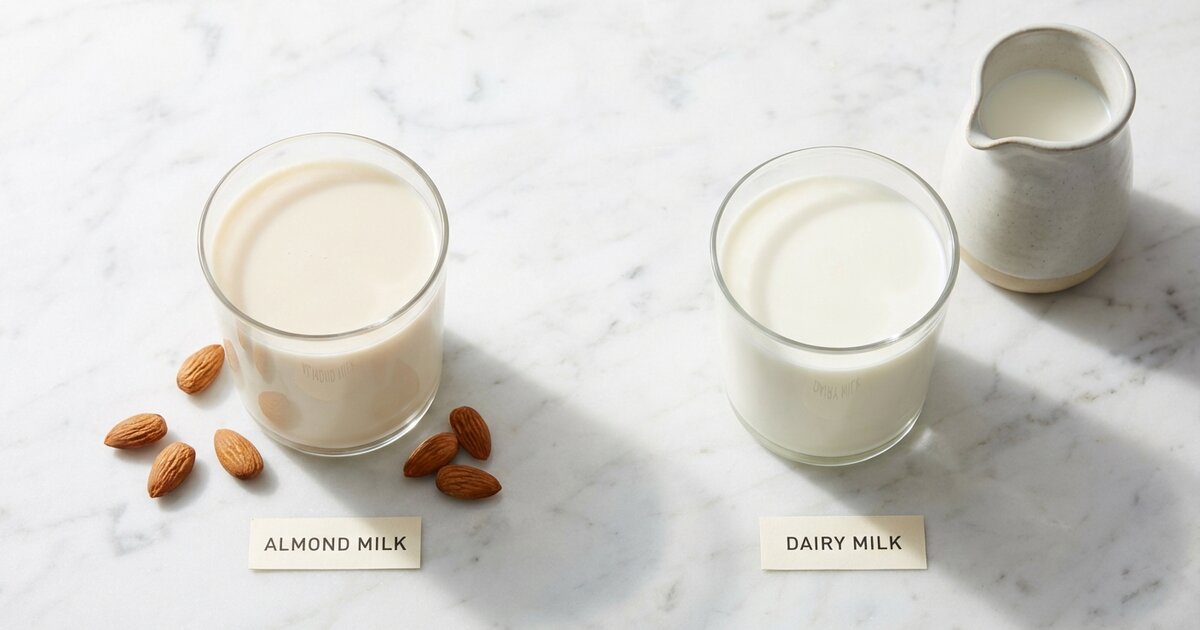
Almond milk and regular milk are fundamentally different products despite both being called “milk.” Regular dairy milk is a complete food with protein, carbs, fat, and dozens of nutrients. Almond milk is essentially almond-flavored water with added vitamins.
This isn’t to say almond milk is bad—it’s useful for cutting calories or avoiding dairy. But the macro comparison reveals just how different these liquids are. Understanding the trade-offs helps you choose the right one for your goals.
Quick Comparison Table
Here’s the head-to-head breakdown per 1 cup (8 oz / 240ml):
| Nutrient | Almond Milk (Unsweetened) | Whole Milk | Skim Milk |
|---|---|---|---|
| Calories | 30 | 149 | 83 |
| Protein | 1g | 8g | 8g |
| Carbs | 1g | 12g | 12g |
| Sugar | 0g | 12g | 12g |
| Fat | 2.5g | 8g | 0.2g |
| Calcium | 450mg* | 276mg | 299mg |
*Fortified. Unfortified almond milk has ~7mg calcium.
Winner for calories: Almond milk (by far) Winner for nutrition: Regular milk (by far)
Detailed Macro Breakdown
Almond Milk, Unsweetened (1 cup / 240ml)
| Macro | Amount |
|---|---|
| Calories | 30 kcal |
| Protein | 1g |
| Carbohydrates | 1g |
| Sugar | 0g |
| Fat | 2.5g |
| Fiber | 0g |
| Calcium | 450mg (fortified) |
Almond milk is made by blending almonds with water and straining. Commercial versions are typically 2% almonds—the rest is water and additives. This extreme dilution explains the minimal nutrition.
Regular Whole Milk (1 cup / 240ml)
| Macro | Amount |
|---|---|
| Calories | 149 kcal |
| Protein | 8g |
| Carbohydrates | 12g |
| Sugar | 12g (lactose) |
| Fat | 8g |
| Saturated Fat | 4.5g |
| Calcium | 276mg |
Whole milk is a nutritionally complete food. The 8g of protein includes all essential amino acids, making it a high-quality protein source.
For complete milk nutrition information, see our guide to milk macros.
Regular Skim Milk (1 cup / 240ml)
| Macro | Amount |
|---|---|
| Calories | 83 kcal |
| Protein | 8g |
| Carbohydrates | 12g |
| Sugar | 12g (lactose) |
| Fat | 0.2g |
| Calcium | 299mg |
Skim milk removes the fat but retains all the protein. It’s the most protein-efficient dairy option.
All Dairy Milk Fat Levels
| Milk Type | Calories | Protein | Fat | Carbs |
|---|---|---|---|---|
| Whole (3.25%) | 149 | 8g | 8g | 12g |
| 2% | 122 | 8g | 5g | 12g |
| 1% | 102 | 8g | 2.4g | 12g |
| Skim | 83 | 8g | 0.2g | 12g |
Key insight: All dairy milk has the same 8g protein—only the fat content varies.
Which Is Better for Weight Loss?
Answer: It depends on your priorities
If Pure Calorie Reduction Is the Goal: Almond Milk
Swapping whole milk for unsweetened almond milk saves 119 calories per cup. If you use milk multiple times daily:
| Usage | Whole Milk | Almond Milk | Savings |
|---|---|---|---|
| 1 cup coffee | 149 cal | 30 cal | 119 cal |
| 2 cups daily | 298 cal | 60 cal | 238 cal |
| Weekly (14 cups) | 2,086 cal | 420 cal | 1,666 cal |
Those 1,666 calories per week could equal nearly half a pound of fat loss per week—significant.
If Protein Matters: Regular Milk
During weight loss, protein preservation is crucial:
- Prevents muscle loss
- Increases satiety
- Maintains metabolism
The 8g protein per cup of regular milk contributes meaningfully to daily needs. Almond milk’s 1g is negligible.
Smart weight loss approach:
- Use unsweetened almond milk in coffee and smoothies (calorie savings)
- Get protein from other sources (Greek yogurt, eggs, lean meat)
- Consider skim milk if you want the protein with fewer calories
Use our macro calculator to determine your protein needs during weight loss.
Which Is Better for Muscle Gain?
Winner: Regular milk
For building muscle, almond milk is essentially useless. Here’s why:
Dairy milk advantages:
- 8g complete protein per cup
- Contains both whey and casein proteins
- Natural source of amino acids for muscle synthesis
- Calorie-dense versions (whole milk) aid surplus
The GOMAD approach: Some hardgainers drink a Gallon Of Milk A Day for easy calories and protein. That provides 128g protein and 2,400 calories from whole milk alone. You couldn’t replicate this with almond milk—you’d get 16g protein for 480 calories (and probably digestive issues from the volume).
When almond milk works for muscle gain:
- As a low-calorie base for protein shakes (the protein powder provides the actual protein)
- When you need liquid volume without extra calories
- If dairy causes digestive issues
For complete muscle-building strategies, read our guide on macros for muscle gain.
Which Is Better for Keto/Low-Carb?
Winner: Unsweetened almond milk
This is almond milk’s clear victory:
| Milk Type | Carbs per Cup | Keto Compatible |
|---|---|---|
| Unsweetened almond milk | 1g | ✓ Excellent |
| Sweetened almond milk | 7-16g | ✗ Varies |
| Heavy cream | 0.4g | ✓ Excellent |
| Whole milk | 12g | ✗ Too high |
| Skim milk | 12g | ✗ Too high |
All dairy milk contains 12g carbs per cup from lactose—too much for strict keto. Unsweetened almond milk at 1g carb is perfect.
Keto tip: Heavy cream provides richness with near-zero carbs but is very calorie-dense (52 calories per tablespoon). Almond milk is better for volume without calories.
Watch out: Sweetened almond milk can have 7-16g carbs per cup. Always choose unsweetened for keto.
For understanding how different milks fit your diet, read our guide on what macronutrients are.
Calcium Comparison
One common concern about switching from dairy: will you get enough calcium?
| Milk Type | Calcium per Cup | % Daily Value |
|---|---|---|
| Fortified almond milk | 450mg | 45% |
| Whole milk | 276mg | 28% |
| Skim milk | 299mg | 30% |
| Unfortified almond milk | 7mg | <1% |
The good news: Fortified almond milk often has MORE calcium than dairy milk because manufacturers add extra.
The catch: Unfortified almond milk has almost zero calcium. Always check labels—“fortified” matters.
Absorption note: Dairy calcium may be better absorbed than calcium added to almond milk, though both count toward daily needs.
Taste and Use Case Considerations
Almond Milk
Best uses:
- Coffee (adds creaminess without many calories)
- Smoothies (low-calorie liquid base)
- Cereal (if you want fewer calories)
- Baking (some substitution works)
Flavor profile:
- Subtle almond flavor
- Lighter, more watery than dairy
- Some find it “thin” compared to milk
Texture:
- Much thinner than whole milk
- Doesn’t foam as well for lattes
- Can separate in hot coffee
Regular Milk
Best uses:
- Drinking straight
- Protein shakes (adds protein + liquid)
- Cooking and baking
- Frothed for lattes
- Cereal (traditional)
Flavor profile:
- Rich, creamy, familiar
- Slight sweetness from lactose
- Full-bodied mouthfeel
Texture:
- Thick and creamy (whole milk)
- Foams beautifully
- Consistent texture
Cost Comparison
| Milk Type | Average Price/Half Gallon |
|---|---|
| Store brand almond milk | $2.50-3.50 |
| Name brand almond milk | $3.50-5.00 |
| Whole milk | $2.00-3.00 |
| Organic whole milk | $4.00-6.00 |
| Skim milk | $2.00-3.00 |
Winner: Regular milk (slightly)
Regular milk is typically 10-30% cheaper than almond milk. The price difference is small, though—not a major factor for most people.
Value consideration: Per gram of protein, regular milk is FAR cheaper:
- Whole milk: ~$0.04 per gram protein
- Almond milk: ~$0.50+ per gram protein (essentially infinite—it has almost no protein)
Other Milk Alternatives Compared
If you’re considering non-dairy options beyond almond milk:
| Milk Alternative | Calories | Protein | Carbs | Best For |
|---|---|---|---|---|
| Almond (unsweetened) | 30 | 1g | 1g | Lowest calories |
| Oat milk | 120 | 3g | 16g | Creamiest texture |
| Soy milk | 80 | 7g | 4g | Highest protein |
| Coconut milk | 45 | 0g | 1g | Keto, creamy |
| Cashew milk | 25 | 1g | 1g | Low calorie |
For protein seekers: Soy milk is the only plant milk with comparable protein to dairy (7g vs 8g per cup).
For keto: Unsweetened almond milk, coconut milk, or cashew milk all work well.
For taste/texture: Oat milk is closest to dairy in creaminess but higher in carbs.
Winner by Goal
| Goal | Best Choice | Why |
|---|---|---|
| Weight Loss (calorie focus) | Almond milk | 30 cal vs 83-149 for dairy |
| Weight Loss (protein focus) | Skim milk | 8g protein for 83 calories |
| Muscle Gain | Whole milk | Complete protein + calories |
| Keto | Unsweetened almond | 1g carbs vs 12g |
| Calcium | Either (if fortified) | Both adequate |
| Budget | Regular milk | Cheaper, more nutrition |
| Dairy-Free Lifestyle | Almond milk | No lactose or dairy |
| Coffee Creamer | Personal preference | Almond saves calories |
The Bottom Line
Almond milk and regular milk serve different purposes:
Regular milk is a nutritious food with meaningful protein, carbs, and fat. It’s a legitimate source of nutrition.
Almond milk is a low-calorie liquid that happens to taste like almonds. It’s useful for cutting calories but contributes almost no nutrition beyond fortified vitamins.
Choose almond milk if:
- Cutting calories is your primary goal
- You’re following keto/low-carb
- You’re lactose intolerant or avoiding dairy
- You want a low-calorie smoothie base
Choose regular milk if:
- Protein intake matters
- You want actual nutrition from your “milk”
- You’re building muscle
- You prefer the taste and texture
Best approach: Use both strategically. Almond milk for coffee and low-calorie applications. Regular milk (or skim) when you want the nutrition. Don’t assume almond milk is a nutritional substitute for dairy—it’s not even close.
Frequently Asked Questions
Which has more protein, almond milk or regular milk? Regular milk has far more protein—8g per cup vs just 1g for almond milk. If protein is important, dairy milk wins decisively.
Is almond milk better than regular milk for weight loss? For pure calorie reduction, yes—unsweetened almond milk has 30 calories vs 83-149 for dairy. But you lose significant protein, which matters for satiety and muscle preservation during weight loss.
Can almond milk replace regular milk nutritionally? Not completely. Almond milk is much lower in protein and naturally occurring nutrients. It works as a low-calorie liquid but shouldn’t be your only “milk” if you need the nutrition dairy provides.
Is almond milk good for building muscle? Not really. With only 1g protein per cup, almond milk contributes almost nothing to muscle-building goals. Use it as a low-calorie mixer, but get protein from other sources.
Does almond milk have calcium like regular milk? Fortified almond milk has similar calcium (about 450mg per cup) to dairy milk. Check labels—unfortified versions have very little calcium.
Which milk is better for keto? Unsweetened almond milk is better—1g carbs vs 12g for dairy milk. Heavy cream or half-and-half also work well on keto while providing more richness.
Why does almond milk have so little protein? Almond milk is mostly water with a small amount of almonds (typically 2%). The protein from the almonds gets diluted significantly. Whole almonds have 6g protein per ounce.
Is almond milk healthy or just hype? It’s low-calorie and works for those avoiding dairy, but it’s not nutritionally comparable to regular milk. It’s best viewed as flavored water with some added vitamins, not a true milk replacement.
Related Articles

Travel Macros: How to Track Nutrition While Traveling
Complete guide to managing macros while traveling. Learn meal planning strategies,...
Read guide →
Macros for Shift Workers: Complete Guide to Nutrition on Rotating Schedules
Master macro tracking on night shifts and rotating schedules. Learn meal timing, sleep...
Read guide →
Macros During Ramadan: Complete Nutrition Guide for Fasting
Learn how to track macros during Ramadan fasting. Expert guide covering meal timing,...
Read guide →Disclaimer: This content is for informational purposes only. Consult a healthcare provider before making changes to your diet.