Macro Cycling: Complete Guide to Carb & Calorie Cycling for Results
Reviewed by Dr. Michael Torres, PhD
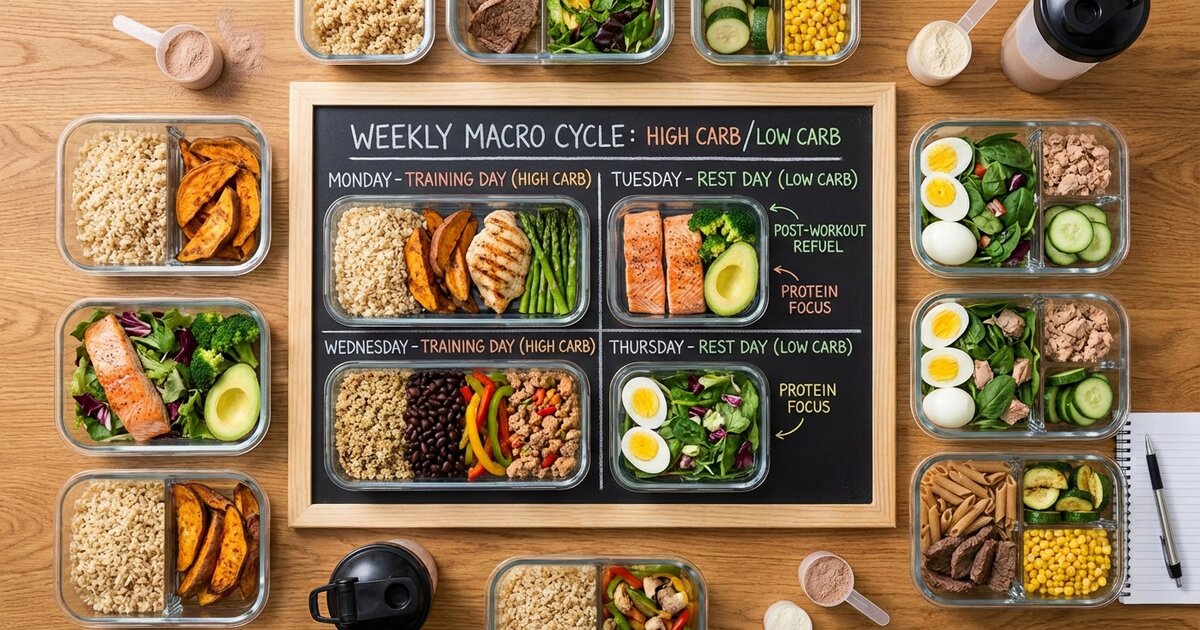
You’ve been hitting the same macros every day—same protein, same carbs, same fat. It works, but you’re wondering: is there a better way? What if you could eat more on days you train hard and less on days you rest, optimizing fuel for performance while maximizing fat loss?
That’s macro cycling. Also called carb cycling or calorie cycling, it’s the practice of strategically varying your macronutrient intake based on your activity level and training schedule. Instead of eating 200g of carbs every single day, you might eat 300g on heavy leg day and 100g on your rest day.
Is it necessary? No. Does it work? For the right person, absolutely. This guide covers everything: what macro cycling actually is, who benefits from it, how to set up your own protocol, sample weekly schedules, and the common mistakes that derail people.
First, know your baseline numbers. The Macro Calculator sets your starting point—then you can cycle from there.
What Is Macro Cycling?
Macro cycling is the strategic variation of your macronutrient intake—primarily carbohydrates—based on your daily energy demands. Rather than eating identical macros every day, you align your intake with your activity:
- Training days: Higher carbs and/or calories to fuel performance and recovery
- Rest days: Lower carbs and/or calories since energy demands are reduced
The core principle is simple: fuel the work, don’t fuel the couch.
The Three Main Approaches
1. Carb Cycling (Most Common) Vary carbohydrate intake while keeping protein constant and adjusting fat inversely.
| Day Type | Carbs | Fat | Protein |
|---|---|---|---|
| High Carb | ↑ Higher | ↓ Lower | Same |
| Low Carb | ↓ Lower | ↑ Higher | Same |
2. Calorie Cycling Vary total calories by adjusting both carbs and fat.
| Day Type | Calories | Carbs | Fat | Protein |
|---|---|---|---|---|
| High Day | ↑ Higher | ↑ Higher | Moderate | Same |
| Low Day | ↓ Lower | ↓ Lower | Moderate | Same |
3. Hybrid Approach Combine both—higher carbs AND higher total calories on training days.
Most practical protocols use a hybrid approach where training days are both higher carb and higher calorie.
How It Differs From Traditional IIFYM
Traditional macro tracking (IIFYM—If It Fits Your Macros) sets static daily targets:
- Same protein, carbs, fat every day
- Simple to track and follow
- Effective for most goals
Macro cycling adds a layer of periodization:
- Different targets for different days
- More complex but potentially more optimized
- Better suited for performance-focused individuals
Neither is inherently better. Consistency with any approach beats inconsistency with the “perfect” approach.
How to Count Macros covers the fundamentals before adding cycling complexity.
The Science Behind Macro Cycling
Why would varying carbs by training day matter? Several physiological mechanisms support the approach:
Glycogen Dynamics
Carbohydrates are stored in your muscles and liver as glycogen—your body’s primary fuel for intense exercise. When you train hard, you deplete glycogen. Eating carbs replenishes it.
- Training days: High glycogen needs for performance and recovery
- Rest days: Minimal glycogen depletion, lower replenishment needs
By eating more carbs around training, you ensure full glycogen stores for performance while not oversupplying on days you don’t need the fuel.
Insulin Sensitivity
Resistance training increases insulin sensitivity in the hours after exercise. This means your muscles are primed to absorb glucose efficiently post-workout. Eating carbs during this window directs more nutrients toward muscle recovery rather than fat storage.
Rest days have lower insulin sensitivity. Reducing carbs on these days may help partition nutrients more favorably.
Nutrient Partitioning
Where do the calories you eat actually go? Training days create a “nutrient sink”—your muscles are actively repairing and growing, demanding calories. Rest days have less active repair.
Cycling calories to match demand theoretically improves nutrient partitioning—more calories toward muscle when it’s actively rebuilding, fewer calories stored as fat when demand is low.
Hormonal Considerations
- Leptin: This satiety hormone drops during prolonged calorie restriction. Strategic high carb days may help maintain leptin levels, reducing hunger and metabolic slowdown during a cut.
- Cortisol: Chronic dieting raises cortisol. Higher calorie days provide relief and may help regulate stress hormones.
- Thyroid: T3 (active thyroid hormone) can decline during extended deficits. Periodic higher carb days may help maintain thyroid function.
The Caveats
The science is promising but not conclusive. Most studies compare consistent deficit vs. intermittent higher calorie periods—not specifically carb cycling. Individual responses vary significantly.
The practical reality: Macro cycling works well for some people due to these mechanisms, psychological benefits, or simply better adherence. It’s not magic, but it’s a legitimate tool.
TDEE Explained helps you understand how your daily energy expenditure changes with activity.
Who Benefits Most From Macro Cycling?
Macro cycling isn’t for everyone. It adds complexity, and complexity without purpose is just noise. Here’s who actually benefits:
Serious Athletes and Lifters
If you train intensely 4-6 days per week with significant volume, macro cycling makes sense. You genuinely have different energy demands on training vs. rest days.
Benefits:
- Fuel hard training sessions adequately
- Support recovery without excess calories
- Maintain performance during a cut
Body Recomposition Goals
Trying to lose fat while building muscle? Cycling can help. Higher calories on training days support muscle protein synthesis, while lower calories on rest days create an overall deficit for fat loss.
Body Recomposition Macros covers this strategy in detail.
People Who’ve Plateaued
If you’ve been eating static macros for months and progress has stalled, introducing cycling can provide a new stimulus—both physiologically and psychologically.
Those Who Prefer Dietary Variation
Some people hate eating the same thing every day. Cycling provides built-in variety: higher carb days feel like a break, low carb days feel purposeful. This psychological benefit shouldn’t be underestimated.
Who Should Stick With Static Macros
- Beginners: Master the basics first. Consistent macros are easier to track and learn.
- Casual exercisers: If you train 2-3 times per week, the difference between training and rest days isn’t dramatic enough to warrant cycling.
- People who struggle with consistency: Adding complexity to an already challenging habit can backfire.
- Anyone overwhelmed by tracking: Keep it simple until tracking feels automatic.
How to Set Up Your Macro Cycling Protocol
Ready to try it? Here’s a step-by-step setup guide:
Step 1: Establish Your Weekly Budget
Your weekly calorie intake matters more than daily fluctuations. Calculate your goal:
For Fat Loss: Weekly budget = (TDEE - 500) × 7 days = Weekly target Example: (2,500 - 500) × 7 = 14,000 calories/week
For Maintenance: Weekly budget = TDEE × 7 days Example: 2,500 × 7 = 17,500 calories/week
For Muscle Gain: Weekly budget = (TDEE + 300) × 7 days Example: (2,500 + 300) × 7 = 19,600 calories/week
Step 2: Identify Your Day Types
Look at your weekly training schedule:
| Day | Activity | Category |
|---|---|---|
| Monday | Heavy Legs | High |
| Tuesday | Upper Body | Medium |
| Wednesday | Rest | Low |
| Thursday | Push Day | Medium |
| Friday | Pull Day | High |
| Saturday | Light Cardio | Low |
| Sunday | Rest | Low |
High days: Your hardest, most demanding sessions (heavy compounds, high volume) Medium days: Moderate training Low days: Rest or very light activity
Step 3: Set Protein (Constant)
Protein stays the same every day:
- Target: 0.8-1g per pound of bodyweight
- Example (175 lb person): 150-175g daily, every day
Why constant? Muscle protein synthesis is elevated for 24-48 hours after training. You need protein on rest days too. Varying protein adds unnecessary complexity.
Step 4: Distribute Calories and Carbs
Using your weekly budget, allocate more to high days and less to low days.
Example: 14,000 cal/week budget for fat loss
| Day Type | # of Days | Calories/Day | Total |
|---|---|---|---|
| High | 2 | 2,400 | 4,800 |
| Medium | 2 | 2,000 | 4,000 |
| Low | 3 | 1,700 | 5,100 |
| Total | 7 | — | 13,900 |
(Close to 14,000—adjust slightly as needed)
Step 5: Set Carbs and Fat
With calories set, distribute macros. Keep protein constant, vary carbs primarily, adjust fat to balance calories.
Example 175 lb person:
| Day Type | Calories | Protein | Carbs | Fat |
|---|---|---|---|---|
| High | 2,400 | 170g | 300g | 55g |
| Medium | 2,000 | 170g | 200g | 55g |
| Low | 1,700 | 170g | 100g | 65g |
Notice:
- Protein: Same every day (170g)
- Carbs: Highest on high days, lowest on low days
- Fat: Increases slightly on low carb days to provide adequate calories
Step 6: Match Days to Your Training
Assign your calculated day types to your actual training schedule:
| Day | Training | Day Type | Macros |
|---|---|---|---|
| Monday | Heavy Legs | High | 170P/300C/55F |
| Tuesday | Upper Body | Medium | 170P/200C/55F |
| Wednesday | Rest | Low | 170P/100C/65F |
| Thursday | Push | Medium | 170P/200C/55F |
| Friday | Pull + Core | High | 170P/300C/55F |
| Saturday | Walk/Light | Low | 170P/100C/65F |
| Sunday | Rest | Low | 170P/100C/65F |
Step 7: Implement and Track
- Track everything for 2-3 weeks
- Monitor weekly weight averages (not daily)
- Assess training performance
- Adjust if needed
How to Track Your Macros covers tracking tools and techniques.
Sample Macro Cycling Protocols
Here are complete protocols for different goals:
Protocol 1: Fat Loss (Moderate Deficit)
Goal: Lose fat while preserving muscle and training performance Weekly Average: ~500 calorie deficit from TDEE
Setup (175 lb person, 2,500 TDEE):
| Day Type | Days | Calories | Protein | Carbs | Fat |
|---|---|---|---|---|---|
| High | 2 | 2,500 | 175g | 280g | 65g |
| Medium | 2 | 2,000 | 175g | 175g | 60g |
| Low | 3 | 1,650 | 175g | 100g | 65g |
Weekly Average: ~2,000 calories (500 deficit)
Sample Week:
Monday (High - Leg Day)
- Breakfast: Oatmeal with banana and protein powder (60P/80C/10F)
- Lunch: Chicken, rice, vegetables (45P/65C/15F)
- Pre-workout: Rice cakes, banana, protein shake (30P/60C/5F)
- Post-workout: Whey shake, white rice (30P/50C/5F)
- Dinner: Lean beef, sweet potato, salad (50P/45C/20F)
- Snack: Greek yogurt (20P/20C/5F)
- Totals: ~235P/320C/60F (adjust portions as needed)
Wednesday (Low - Rest Day)
- Breakfast: Eggs, avocado, vegetables (35P/10C/25F)
- Lunch: Salmon, large salad with olive oil (45P/15C/25F)
- Snack: Nuts, cheese, vegetables (20P/10C/20F)
- Dinner: Chicken thighs, roasted vegetables (50P/20C/25F)
- Evening: Casein protein shake (25P/5C/3F)
- Totals: ~175P/60C/98F (high fat variant)
Protocol 2: Body Recomposition
Goal: Lose fat while building muscle simultaneously Weekly Average: At or slightly below maintenance
Setup (160 lb person, 2,300 TDEE):
| Day Type | Days | Calories | Protein | Carbs | Fat |
|---|---|---|---|---|---|
| High | 3 | 2,600 | 160g | 320g | 60g |
| Low | 4 | 2,000 | 160g | 150g | 70g |
Weekly Average: ~2,260 calories (slight deficit)
The training day surplus supports muscle growth; rest day deficit creates overall fat loss.
Protocol 3: Lean Bulk
Goal: Build muscle with minimal fat gain Weekly Average: ~200-300 calorie surplus
Setup (180 lb person, 2,700 TDEE):
| Day Type | Days | Calories | Protein | Carbs | Fat |
|---|---|---|---|---|---|
| High | 4 | 3,200 | 180g | 400g | 70g |
| Low | 3 | 2,500 | 180g | 250g | 70g |
Weekly Average: ~2,900 calories (+200 surplus)
Surplus calories land on training days when they can be used for recovery and growth.
Protocol 4: Performance Athlete
Goal: Optimize training performance while managing body composition Weekly Average: At maintenance or slight surplus
Setup (190 lb athlete, 3,200 TDEE, training 6 days):
| Day Type | Days | Calories | Protein | Carbs | Fat |
|---|---|---|---|---|---|
| Competition/Heavy | 2 | 3,800 | 190g | 500g | 65g |
| Moderate Training | 4 | 3,200 | 190g | 375g | 70g |
| Active Recovery | 1 | 2,600 | 190g | 250g | 75g |
Weekly Average: ~3,260 calories
Highest carbs on the most demanding days (competition, heavy volume sessions).
Macros for Muscle Gain covers bulking strategies in more detail.
High, Medium, and Low Carb Day Food Choices
What you eat matters as much as how much. Here are practical food choices for each day type:
High Carb Day Foods
Prioritize high-quality carbohydrates that digest easily and replenish glycogen:
Starches:
- White rice, jasmine rice
- Potatoes, sweet potatoes
- Oatmeal, cream of rice
- Pasta (white or whole grain)
- Bread, bagels
Fruits:
- Bananas
- Berries
- Apples, oranges
- Dried fruit (dates, raisins)
Around Workouts:
- Fast-digesting carbs (rice cakes, white rice, fruit)
- Lower fiber for easier digestion
- Pair with protein
Protein Sources (lean):
- Chicken breast
- White fish
- Turkey
- Egg whites
- Lean beef
Fats (limited):
- Small amounts of cooking oil
- Minimal added fats
- Low-fat dairy
Low Carb Day Foods
Prioritize fats, fiber, and protein-rich foods that keep you full with fewer carbs:
Fats:
- Avocado
- Nuts (almonds, walnuts, macadamias)
- Olive oil, avocado oil
- Nut butters
- Fatty fish (salmon, mackerel)
- Whole eggs
- Cheese
Proteins (can include fattier cuts):
- Chicken thighs
- Salmon
- Beef (various cuts)
- Whole eggs
- Full-fat Greek yogurt
Vegetables (unlimited):
- Leafy greens (spinach, kale, lettuce)
- Broccoli, cauliflower
- Asparagus, green beans
- Peppers, cucumbers
- Zucchini, mushrooms
Minimal:
- Berries (small portion if desired)
- Avoid: bread, rice, pasta, potatoes, sugary foods
Medium Day Foods
A balance—include some starchy carbs around training, but don’t go overboard:
- Moderate portions of rice/potatoes with meals
- Normal mixed meals
- Some fruit
- Moderate fat sources
- Think: “normal healthy eating”
Macro-Friendly Meals has recipe ideas for all day types.
Macro Cycling vs. Traditional IIFYM
How does cycling compare to eating the same macros daily? Here’s an honest breakdown:
| Factor | Macro Cycling | Static Macros |
|---|---|---|
| Complexity | Higher | Lower |
| Adherence | Variable (some love it, some hate it) | Generally easier |
| Performance optimization | Potentially better (fuel matches demand) | Good with adequate carbs |
| Fat loss rate | Similar when weekly average is equal | Similar |
| Muscle retention | Potentially slight advantage | Good with adequate protein |
| Flexibility | Less flexible day-to-day | More predictable |
| Best for | Serious athletes, recomp, plateau-breakers | Most people, beginners |
The Research Says…
Studies comparing continuous restriction vs. intermittent approaches (closest research to carb cycling) show:
- Similar fat loss when calorie averages match
- Potential muscle retention benefits with higher calorie days
- Improved adherence for some individuals with built-in breaks
- No metabolic magic—weekly averages still determine results
The bottom line: both approaches work. Choose based on your lifestyle, preferences, and ability to track consistently.
Common Macro Cycling Mistakes
Mistake 1: Making It Too Complicated
Some protocols have 5 different day types, refeed protocols, and complex calculations. This guarantees failure for most people.
Fix: Stick to 2-3 day types maximum. High, medium, and low is plenty.
Mistake 2: Varying Protein
Protein needs don’t change dramatically day-to-day. Cutting protein on low days sacrifices muscle for no reason.
Fix: Keep protein constant—always. It’s the anchor.
Mistake 3: Going Too Extreme on Low Days
Making low days basically zero carb tanks your energy and can impair sleep, mood, and recovery.
Fix: “Low” carb doesn’t mean “no” carb. 100-150g is low for most active people. True keto-level carbs aren’t necessary.
Mistake 4: Overeating on High Days
High carb day isn’t “cheat day.” Some people use it as an excuse to massively overeat, wiping out their weekly deficit.
Fix: High days have specific targets too. Track them just as carefully as low days.
Mistake 5: Ignoring Weekly Averages
Getting obsessed with daily numbers while missing the weekly picture.
Fix: Track your weekly calorie average. That determines fat loss or gain, not daily fluctuations.
Mistake 6: Mismatching Days
Putting high carb days on rest days and low days on training days defeats the purpose entirely.
Fix: High days = hardest training. Always.
Mistake 7: Expecting Magic
Macro cycling is a tool, not a hack. If your weekly average is wrong, cycling won’t save you.
Fix: Get the fundamentals right first. Cycling optimizes at the margins.
Common Macro Tracking Mistakes covers other pitfalls to avoid.
Advanced Cycling Strategies
For experienced individuals who’ve mastered the basics:
Refeed Days
Periodic very high carb days (maintenance or above) during extended cuts. Purposes:
- Leptin restoration
- Glycogen replenishment
- Psychological break
- Training performance boost
Protocol: One day per 1-2 weeks at maintenance, with carbs comprising 60%+ of calories.
Training Block Periodization
Match cycling to your training periodization:
- High volume blocks: More high carb days, slightly higher weekly average
- Deload weeks: More low days, lower weekly average
- Competition/peak: Maximum carb support before events
Targeted Carb Timing
Within high carb days, concentrate carbs around training:
- Pre-workout: 30-50g carbs 1-2 hours before
- Post-workout: 50-100g carbs within 2 hours after
- Other meals: Moderate carbs distributed throughout
This maximizes performance and glycogen replenishment benefits.
Weekly Refeed Cycles
For extended cuts (12+ weeks):
- Weeks 1-3: Standard cycling protocol
- Week 4: Full week at maintenance
- Repeat
Longer maintenance periods help prevent metabolic adaptation.
Is Macro Cycling Right for You?
Ask yourself:
- Am I training intensely 4+ days per week? If not, stick with static macros.
- Have I mastered basic macro tracking? If tracking is still challenging, don’t add complexity.
- Do I have a specific performance or body composition goal? Cycling is most valuable for optimization, not basics.
- Am I okay with more tracking and planning? This requires more mental energy than static macros.
- Does dietary variation appeal to me? Some people love it; others find it stressful.
If you answered yes to most, macro cycling may be worth trying. If not, there’s no shame in static macros—they work great for most people.
Getting Started: Your First Week
Ready to try? Here’s a simple starting protocol:
Week 1 Setup
- Calculate your baseline using the Macro Calculator
- Identify 2 high days, 2 medium days, 3 low days
- Set protein at 0.85g/lb every day
- High days: Baseline + 300 calories (add ~75g carbs)
- Low days: Baseline - 200 calories (subtract ~50g carbs)
- Medium days: Baseline calories
Track Everything
- Log all food for 7 days
- Weigh yourself daily (same conditions)
- Note energy levels and workout performance
Week 2: Assess and Adjust
- How did your weekly weight average compare to goals?
- Was training performance adequate on high days?
- Did you feel overly restricted on low days?
Adjust calorie allocations based on real-world feedback.
Summary
Macro cycling isn’t magic, and it isn’t necessary for everyone. But for athletes, serious lifters, body recomposition seekers, and those who thrive with dietary variation—it’s a legitimate strategy that can optimize results.
The key principles:
- Fuel the work, not the rest
- Keep protein constant
- Weekly averages determine outcomes
- Match high days to hard training
- Keep it simple enough to actually follow
Whether you cycle or eat static macros, consistency wins. Pick the approach you’ll actually follow, track your progress, and adjust based on results—not theory.
Maintenance Macros Guide covers what to do when you’re ready to stabilize after cutting or bulking phases.
Part of our Flexible Dieting philosophy.
References
- Helms ER, Aragon AA, Fitschen PJ. Evidence-based recommendations for natural bodybuilding contest preparation: nutrition and supplementation. J Int Soc Sports Nutr. 2014;11:20.
- Peos JJ, Norton LE, Helms ER, Galpin AJ, Fournier P. Intermittent Dieting: Theoretical Considerations for the Athlete. Sports (Basel). 2019;7(1):22.
- Escalante G, Campbell BI, Norton L. Effectiveness of Diet Refeeds and Diet Breaks as a Precompetition Strategy. Strength Cond J. 2020;42(5):102-107.
- Trexler ET, Smith-Ryan AE, Norton LE. Metabolic adaptation to weight loss: implications for the athlete. J Int Soc Sports Nutr. 2014;11(1):7.
- Ivy JL. Glycogen resynthesis after exercise: effect of carbohydrate intake. Int J Sports Med. 1998;19 Suppl 2:S142-S145.
- Burke LM, Hawley JA, Wong SH, Jeukendrup AE. Carbohydrates for training and competition. J Sports Sci. 2011;29 Suppl 1:S17-S27.
Related Articles

Travel Macros: How to Track Nutrition While Traveling
Complete guide to managing macros while traveling. Learn meal planning strategies,...
Read guide →
Macros for Shift Workers: Complete Guide to Nutrition on Rotating Schedules
Master macro tracking on night shifts and rotating schedules. Learn meal timing, sleep...
Read guide →
Macros During Ramadan: Complete Nutrition Guide for Fasting
Learn how to track macros during Ramadan fasting. Expert guide covering meal timing,...
Read guide →Disclaimer: This content is for informational purposes only. Consult a healthcare provider before making changes to your diet.