Quinoa vs Rice: Which Is Better for Your Macros?
Reviewed by Jessica Williams, CPT, CSCS
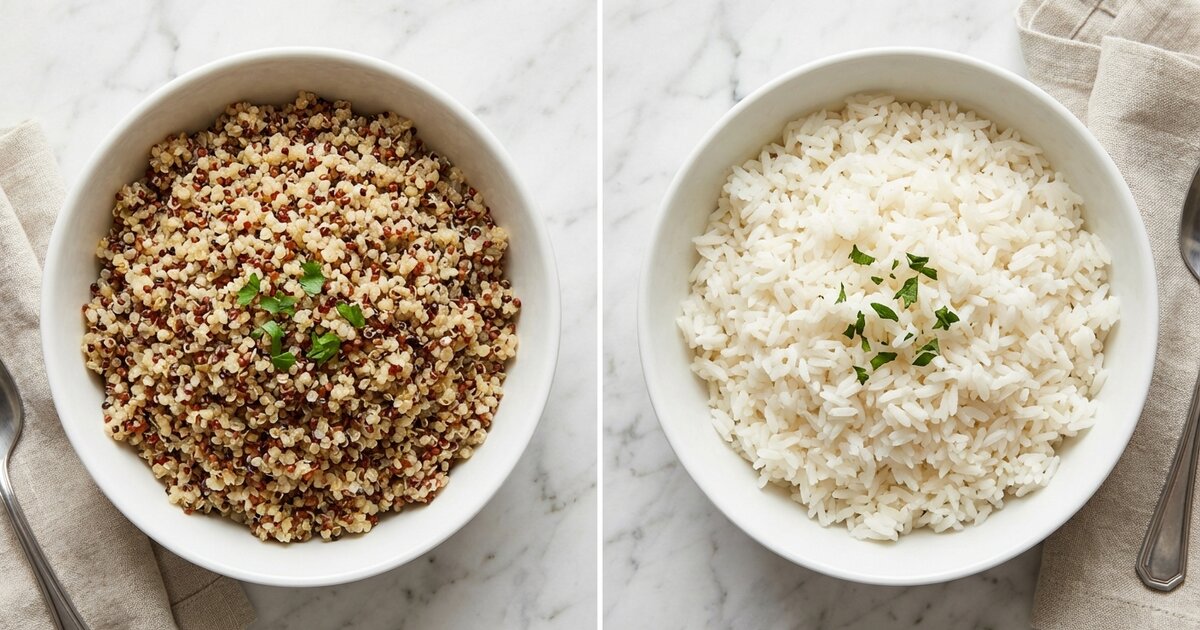
Quinoa has been marketed as a “superfood” that’s supposedly far superior to humble rice. But is the hype justified, or is rice perfectly adequate for most people?
The answer depends on your goals. Quinoa has meaningful nutritional advantages—more protein, complete amino acids, more fiber. But rice is cheaper, more versatile, and not as inferior as health marketing suggests.
This guide breaks down the complete comparison so you can decide which grain deserves a place in your meal prep.
Quick Comparison Table
Here’s the head-to-head breakdown per 100g cooked:
| Nutrient | Quinoa | White Rice | Brown Rice |
|---|---|---|---|
| Calories | 120 | 130 | 112 |
| Protein | 4.4g | 2.7g | 2.6g |
| Carbs | 21g | 28g | 24g |
| Fiber | 2.8g | 0.4g | 1.8g |
| Fat | 1.9g | 0.3g | 0.9g |
| Net Carbs | 18.2g | 27.6g | 22.2g |
| Complete Protein | ✓ Yes | ✗ No | ✗ No |
Winner for protein: Quinoa Winner for affordability: Rice
Detailed Macro Breakdown
Quinoa (100g cooked)
| Macro | Amount |
|---|---|
| Calories | 120 kcal |
| Protein | 4.4g |
| Carbohydrates | 21g |
| Fiber | 2.8g |
| Net Carbs | 18.2g |
| Fat | 1.9g |
| Sugar | 0.9g |
Quinoa is technically a seed, not a grain—but it’s used like a grain in cooking. Its claim to fame is being a complete protein, containing all nine essential amino acids.
For complete nutrition information, see our guide to quinoa macros.
White Rice (100g cooked)
| Macro | Amount |
|---|---|
| Calories | 130 kcal |
| Protein | 2.7g |
| Carbohydrates | 28g |
| Fiber | 0.4g |
| Net Carbs | 27.6g |
| Fat | 0.3g |
| Sugar | 0g |
White rice is a staple carb worldwide—affordable, easy to cook, and extremely versatile. It’s lower in protein and fiber than quinoa but serves its purpose as a carb source.
For complete nutrition information, see our guide to white rice macros.
Brown Rice (100g cooked)
| Macro | Amount |
|---|---|
| Calories | 112 kcal |
| Protein | 2.6g |
| Carbohydrates | 24g |
| Fiber | 1.8g |
| Net Carbs | 22.2g |
| Fat | 0.9g |
| Sugar | 0.4g |
Brown rice keeps the bran layer that white rice removes, providing more fiber and nutrients. It’s closer to quinoa nutritionally but still lacks the complete protein profile.
For complete nutrition information, see our guide to brown rice macros.
Per Cup Cooked (More Practical Serving)
| Nutrient | Quinoa (185g) | White Rice (195g) | Brown Rice (195g) |
|---|---|---|---|
| Calories | 222 | 254 | 218 |
| Protein | 8.1g | 5.3g | 5g |
| Carbs | 39g | 55g | 46g |
| Fiber | 5.2g | 0.8g | 3.5g |
The Complete Protein Advantage
Quinoa’s biggest claim to fame is being a complete protein. Here’s what that means:
Essential amino acids: Your body needs 9 amino acids from food (it can’t make them). A “complete” protein contains all 9 in adequate amounts.
Quinoa: Contains all 9 essential amino acids ✓ Rice: Low in lysine, making it “incomplete” ✗
Why this matters:
- Vegetarians and vegans benefit most—quinoa provides complete protein without meat
- For meat-eaters, it matters less—you’re getting complete proteins from animal sources anyway
Practical impact: If you eat meat, eggs, or dairy, rice’s incomplete protein isn’t an issue. If you’re plant-based, quinoa’s complete profile is valuable.
Which Is Better for Weight Loss?
Winner: Quinoa (slight edge)
Quinoa has three advantages for weight loss:
- More protein – 4.4g vs 2.7g per 100g helps with satiety and muscle preservation
- More fiber – 2.8g vs 0.4g keeps you fuller longer
- Fewer calories – 120 vs 130 per 100g (small difference)
The reality check: The difference is modest. Per cup, you save about 30 calories choosing quinoa over white rice. That’s one bite of food.
What actually matters:
- Portion control (measure your grains)
- Overall calorie balance
- Protein from your main protein sources (meat, eggs, dairy)
Weight loss strategy: If you like quinoa, eat it. If you prefer rice, eat rice. Both can fit a weight loss diet. The grain you choose matters far less than how much you eat.
Use our macro calculator to set your carb targets for weight loss.
Which Is Better for Muscle Gain?
Winner: Rice (for most bodybuilders) or Quinoa (for vegetarians)
This might surprise you: despite quinoa’s better protein profile, many bodybuilders prefer rice.
Why rice works for muscle building:
- Easier to eat in volume – When bulking, you need lots of carbs. Rice’s mild flavor and soft texture make high-volume eating easier.
- Faster digestion – White rice provides quick energy before/after workouts
- Cheaper – Serious athletes eat pounds of carbs weekly. Cost matters.
- No bloating – Some people find quinoa’s fiber causes gas in large amounts
When quinoa is better:
- Vegetarian/vegan athletes who need plant protein
- Those who prefer quinoa’s taste
- When eating moderate portions (not extreme bulking)
The protein reality: Even quinoa doesn’t provide enough protein for muscle building on its own. You need dedicated protein sources (meat, eggs, protein powder). The grain is just for carbs and shouldn’t be your protein strategy.
For complete muscle-building nutrition, read our guide on macros for muscle gain.
Which Is Better for Keto/Low-Carb?
Winner: Neither (but quinoa is slightly lower)
Both quinoa and rice are too high in carbs for strict keto:
| Grain | Net Carbs per Cup | Typical Keto Limit |
|---|---|---|
| Quinoa | 34g | 20-50g/day |
| White Rice | 54g | 20-50g/day |
| Brown Rice | 42g | 20-50g/day |
One cup of either grain would exceed or consume most of your daily carb allowance.
Low-carb alternatives:
- Cauliflower rice: 5g carbs per cup
- Shirataki rice: 1g carbs per serving
- Riced broccoli: 4g carbs per cup
Carb-cycling option: If you do targeted keto or carb cycling, rice is better for refeed days—faster digestion means faster glycogen replenishment.
For understanding how carbs fit into your diet, read our guide on what macronutrients are.
Taste and Cooking Considerations
Quinoa
Flavor profile:
- Nutty, slightly earthy
- Distinct taste some people love, others don’t
- More interesting than plain rice
Texture:
- Slight “pop” when you bite
- Fluffy but with more structure than rice
- Some describe as “caviar-like”
Cooking:
- 15-20 minutes (faster than rice)
- 1:2 quinoa-to-water ratio
- Should rinse before cooking to remove bitter coating
Best uses:
- Grain bowls
- Salads (holds dressing well)
- When you want the grain to have presence
- Plant-based protein needs
Rice (White)
Flavor profile:
- Mild, neutral
- Takes on other flavors well
- Comforting, familiar
Texture:
- Soft, fluffy (when cooked right)
- Sticky or separate depending on type
- Easy to eat in large amounts
Cooking:
- 15-20 minutes for white rice
- 1:1.5 to 1:2 rice-to-water ratio depending on type
- Rinse for fluffier results
Best uses:
- Asian cuisines
- When you want carbs to be background
- Pairing with flavorful proteins and sauces
- High-volume eating
Rice (Brown)
Flavor profile:
- Nuttier than white rice
- Chewier, more earthy
- Heartier mouthfeel
Texture:
- Chewier, more substantial
- Less sticky than white rice
- Can seem “tougher”
Cooking:
- 40-50 minutes (much longer)
- 1:2.5 rice-to-water ratio
- Can soak to reduce cooking time
Cost Comparison
| Grain | Average Price/lb | Cost per Cup Cooked |
|---|---|---|
| White rice (long-grain) | $1.00-1.50 | $0.15-0.20 |
| Brown rice | $1.50-2.00 | $0.20-0.30 |
| Quinoa (bulk) | $3.00-5.00 | $0.50-0.80 |
| Quinoa (pre-packaged) | $5.00-8.00 | $0.80-1.30 |
Winner: Rice (by far)
Quinoa costs 3-5x more than rice per serving. For occasional use, this doesn’t matter. For daily carb staples, it adds up quickly.
Budget strategy: Use quinoa strategically when you want its benefits (salads, protein variety) and rice for everyday meals.
Micronutrient Comparison
Beyond macros, here’s how these grains compare nutritionally:
| Nutrient | Quinoa | White Rice | Brown Rice |
|---|---|---|---|
| Iron | 15% DV | 10% DV | 5% DV |
| Magnesium | 17% DV | 3% DV | 11% DV |
| Phosphorus | 22% DV | 4% DV | 8% DV |
| Folate | 12% DV | 23% DV* | 2% DV |
| Manganese | 32% DV | 37% DV | 88% DV |
| Zinc | 11% DV | 4% DV | 8% DV |
*White rice is often fortified with folate and iron
Quinoa wins on: Iron, magnesium, phosphorus, zinc Brown rice wins on: Manganese White rice wins on: Folate (fortified)
Quinoa has a broader, stronger micronutrient profile overall.
Winner by Goal
| Goal | Best Choice | Why |
|---|---|---|
| Weight Loss | Quinoa (slight) | More protein and fiber for satiety |
| Muscle Gain (omnivore) | White rice | Easier to eat in volume, cheaper |
| Muscle Gain (vegetarian) | Quinoa | Complete protein source |
| Keto | Neither | Both too high in carbs |
| Budget | Rice | 3-5x cheaper |
| Vegetarian Protein | Quinoa | Complete amino acid profile |
| Quick Cooking | Quinoa | 15-20 min vs 20-45 for rice |
| Micronutrients | Quinoa | Broader mineral profile |
| Versatility | White rice | Works with everything |
The Bottom Line
Quinoa is nutritionally superior to rice—more protein, complete amino acids, more fiber, more micronutrients. If nutrition is your only concern and cost doesn’t matter, quinoa wins.
But here’s the reality:
- The differences aren’t dramatic enough to require quinoa
- Rice has fed billions of people healthily for millennia
- Your protein should come from dedicated protein sources, not grains
- Cost and preference matter for long-term adherence
Choose quinoa if:
- You’re vegetarian/vegan and want plant protein
- You prefer the taste and texture
- You want maximum nutrition from your grains
- Budget isn’t a primary concern
Choose rice if:
- You prefer it and it fits your diet
- Budget matters
- You eat large quantities (bulking)
- You want versatility with different cuisines
Best approach: Use both. Quinoa for salads and when you want its distinct flavor. Rice for everyday meals, Asian dishes, and when you need affordable carbs. Neither is wrong—both are healthy whole foods.
Frequently Asked Questions
Which has more protein, quinoa or rice? Quinoa has 60% more protein—4.4g per 100g cooked vs 2.7g for white rice. Plus, quinoa is a complete protein with all essential amino acids, while rice is incomplete.
Is quinoa better than rice for weight loss? Slightly. Quinoa has more protein and fiber for better satiety, with fewer calories (120 vs 130 per 100g). But the difference is modest—portion control matters more than which grain you choose.
Is quinoa healthier than rice? Nutritionally, yes. Quinoa has more protein, fiber, and micronutrients. It’s also a complete protein, which rice is not. However, both are healthy carb sources.
Can I substitute quinoa for rice in recipes? Yes, in most cases. Quinoa cooks faster (15-20 min vs 20-45 for rice) and has a slightly nutty flavor. The texture is different—quinoa has a slight pop to it.
Is quinoa or rice better for muscle building? Quinoa has an edge due to its complete protein profile and higher protein content. However, for serious muscle building, your protein should come primarily from meat, eggs, or protein powder—not grains.
Can I eat quinoa on keto? Not really. Quinoa has 18g net carbs per 100g cooked—too high for strict keto. It’s lower carb than rice but still a significant carb source.
Why is quinoa more expensive than rice? Quinoa is harder to grow (high altitude, specific climate) and has become popular in Western countries, increasing demand. Rice is grown worldwide in massive quantities, keeping prices low.
Does quinoa taste like rice? Not quite. Quinoa has a nuttier, slightly earthy flavor and a unique texture (slight pop when you bite it). Many people like it, but some need time to adjust from rice.
Related Articles
Travel Macros: How to Track Nutrition While Traveling
Complete guide to managing macros while traveling. Learn meal planning strategies,...
Read guide →
Macros for Shift Workers: Complete Guide to Nutrition on Rotating Schedules
Master macro tracking on night shifts and rotating schedules. Learn meal timing, sleep...
Read guide →
Macros During Ramadan: Complete Nutrition Guide for Fasting
Learn how to track macros during Ramadan fasting. Expert guide covering meal timing,...
Read guide →Disclaimer: This content is for informational purposes only. Consult a healthcare provider before making changes to your diet.